
Janmashtami 2026 in Chesterfield: Events, Puja & Where to Celebrate
Krishna Janmashtami 2026 in Chesterfield: A St. Louis Desi Community's Devotional Midnight
TL;DR
- Krishna Janmashtami 2026 falls on Thursday, September 4, 2026 — observed by Indian/Desi families in Chesterfield and the greater St. Louis South Asian community with day-long fasting, home pujas, and midnight temple celebrations 🕯️
- The devotional fasting tradition is central to Janmashtami in ways that distinguish it from more spectacle-oriented festivals — the fast is an active spiritual practice, not a passive waiting period
- The full summer season runs from Guru Purnima 2026 on July 29 through Ganesh Chaturthi 2026 on September 14, with Janmashtami as the season's most observance-intensive night
- Raksha Bandhan 2026 on August 27 and Nag Panchami 2026 on August 17 precede Janmashtami — families moving through the full calendar arrive at September 4 already in a devotional rhythm
- For Chesterfield families who prefer home puja to large public events, a well-prepared Janmashtami altar and jhula ceremony deliver the full experience
Krishna Janmashtami 2026 in Chesterfield: The Birth That Waits for Midnight
Krishna Janmashtami 2026 arrives on September 4, 2026 — the Ashtami of the Krishna Paksha (waning fortnight) in the Hindu month of Bhadrapada. This is the night Lord Krishna is said to have been born at midnight in a prison cell in Mathura, born to parents Devaki and Vasudeva who had been imprisoned by Devaki's brother Kamsa. The birth was announced by divine signs. The prison doors opened by themselves. A flooding Yamuna River parted for the infant's safe passage to Gokul.
For the Indian/Desi community in Chesterfield, Missouri, that story is not distant mythology. It is a narrative structure that Janmashtami rituals enact directly and deliberately. The day-long fast mirrors the hardship and constraint of the prison vigil. The midnight Aarti celebrates the exact moment of arrival. The jhula (cradle) ceremony rocks the infant into the world. Every element of the observance has a story behind it, and most Chesterfield families who observe Janmashtami carry that layered understanding.
Chesterfield sits in western St. Louis County and has built a well-established South Asian community over several decades. Indian/Desi families here have developed a Janmashtami practice that is simultaneously personal — centered in the home puja — and communal, connecting through temple programs and cultural organization events with the broader St. Louis South Asian community.
The Fasting Tradition: What It Involves and Why It Matters
For many observant Indian/Desi households in Chesterfield, Janmashtami fasting begins at sunrise on September 4 and continues until after the midnight Aarti. The specific form of the fast varies by family tradition and regional background. Vaishnava households — those with a strong devotional orientation toward Vishnu and his avatars, including Krishna — may observe a strict fast abstaining from grains, legumes, and in some cases all solid food. Other families observe a phalahari fast: fruit, dairy, and nuts are permitted, but nothing derived from grain.
The fast is not experienced as deprivation by those who practice it. It is a deliberate clearing of physical preoccupation — a way of directing the body's attention toward devotion rather than appetite. Families who fast together on Janmashtami report that the shared discipline creates a quality of shared presence during the midnight rituals that would be difficult to achieve otherwise. When the Aarti breaks at midnight and prasad is distributed — panchamrit, fruit, sweets made without grain — the relief and the joy arrive together.
Panchamrit deserves its own note. This ritual mixture of milk, curd, honey, ghee, and sugar is used to bathe and bless the Krishna idol during puja and is then distributed as blessed food. For many Indian/Desi adults who grew up in St. Louis, the taste of panchamrit at midnight after a full day's fast is one of their most vivid Janmashtami memories.
For children in Chesterfield's Indian/Desi households, the transition to full fasting is gradual. Young children may observe a modified fruit fast, participating in the spirit of the day without the full physical discipline of their parents. The moment when a young person first keeps the complete Janmashtami fast is often remembered as a personal milestone.
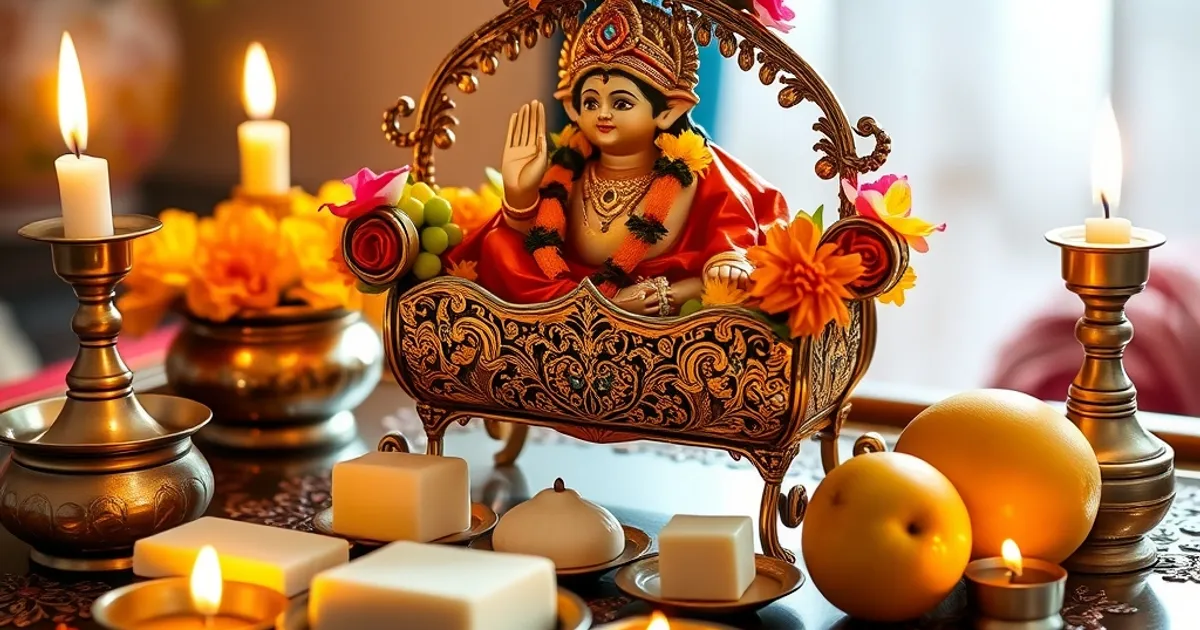
Insider Tip: If you are setting up a home Janmashtami puja in Chesterfield for the first time, the jhula ceremony is the essential element. You need a small brass or silver cradle — widely available at Indian/Desi religious supply stores in the St. Louis area — a Bal Gopal (baby Krishna) idol or image, tulsi leaves, and the ingredients for panchamrit. At midnight, the group rocks the cradle gently while singing "Nand Gher Anand Bhayo" together. The song is simple to learn; its communal performance at the stroke of midnight is one of the most emotionally resonant moments in the entire festival.
What Families Prepare: The Home Altar and Offerings
Home pujas for Janmashtami in Indian/Desi households across Chesterfield involve elaborate preparation of the altar space. A special area is set up with images or idols of Bal Gopal, decorated with flowers, tulsi leaves, and small clay or rangoli footprints traced from the entrance of the home to the altar — symbolizing Krishna's arrival into the household.
Offerings are prepared without grain, honoring the fast: fresh white butter (makhan), milk sweets, fruit, makhana (fox nuts), and dairy-based confections. Many families prepare makhan specifically to offer to the idol — a direct enactment of the Makhan Chor stories, presenting the very item young Krishna was most famous for taking.
The home puja's importance in Chesterfield is amplified by geography. Unlike South Asian communities in larger urban centers where a temple may be only minutes away, Chesterfield families may travel a meaningful distance to access temple programs. Many therefore invest seriously in their home observance, making it thorough, beautiful, and complete in itself. The result is a Janmashtami tradition that feels genuinely domestic — passed between generations inside households, not only inside temples.
The Full Festival Calendar: July Through September 2026
Janmashtami 2026 does not arrive in isolation. The summer and early autumn of 2026 are dense with observances for Hindu families in Chesterfield, and the full sequence gives Janmashtami its context.
Guru Purnima 2026 opens the season on July 29 — a full moon day for honoring teachers, gurus, and guides, observed with puja and temple visits. Nag Panchami 2026 follows on August 17, with offerings to serpent deities and prayers for the protection of the household. Raksha Bandhan 2026 arrives on August 27, bringing siblings together across Chesterfield's South Asian households — and across international video calls — for the rakhi ceremony that crosses regional and linguistic lines.
Between these markers, Pradosh Vrat (July 26/27, August 10, August 25, September 8) and Sankashti Chaturthi (August 2 and August 31) give regularity to the lunar calendar for those who maintain these vrats. By September 4, Krishna Janmashtami 2026 arrives at the summit of a devotional arc that has been building for more than a month. Ten days later, Ganesh Chaturthi 2026 on September 14 carries the energy forward.
For Chesterfield families managing Missouri school calendars and professional schedules, September 4 falling on a Thursday creates a practical consideration: the midnight celebration extends into Friday morning, and September 5 is a standard school and work day. Planning childcare and scheduling a flexible Friday makes the Janmashtami observance far less stressful.
FAQ
Is the Janmashtami fast medically demanding? A strict waterless fast for 18-24 hours is physically demanding and is generally observed only by adults in good health. Fruit-and-dairy fasts, the most common alternative, are considerably more accessible. Use your own judgment and consider any relevant health factors.
What is panchamrit? Panchamrit is a ritual mixture of milk, curd, honey, ghee, and sugar. It is used to bathe the Krishna idol during puja and is then distributed as prasad. It is considered highly auspicious and is one of the defining tastes of the Janmashtami fast-break.
What time does the midnight puja happen? The central Aarti and jhula ceremony are timed to midnight. Home pujas are typically structured by the family; community temple events usually begin in the evening around 7-8 PM and build toward the midnight climax.
Are temple Janmashtami events in the St. Louis area open to visitors? Most Hindu temples in the greater St. Louis area welcome respectful visitors of all backgrounds. Dress conservatively, remove footwear at the entrance, and follow the lead of those already inside.
What traditional sweets are offered and served on Janmashtami? Makhan (white butter), panchamrit, makhana kheer (fox-nut milk pudding), fresh fruit, and various grain-free milk sweets are all traditional. Everything offered observes the no-grain requirement of the fast.
Bottom Line
Krishna Janmashtami 2026 on September 4 is a festival of genuine spiritual depth — structured around fasting, waiting, and a midnight arrival that the community enacts together year after year. For Indian/Desi families in Chesterfield and the greater St. Louis area, it is a home puja as much as a temple event, a personal fast as much as a communal celebration. From Guru Purnima 2026 in late July through Ganesh Chaturthi 2026 in mid-September, the summer holds a full season of observance. Janmashtami is its most devotionally concentrated night.