
Janmashtami 2026 in Cupertino: Events, Puja & Where to Celebrate
TL;DR
- 🎉 Krishna Janmashtami 2026 falls on September 4 — the centerpiece of the Indian community calendar in Cupertino this summer.
- 🌕 The season opens with Guru Purnima 2026 on July 28, a full moon day for honoring teachers and spiritual guides.
- 🐍 Nag Panchami 2026 on August 16 and Raksha Bandhan 2026 on August 27 are key milestones in the lead-up to Janmashtami.
- 🪔 No dedicated temples are listed in Cupertino, so families typically travel to South Bay mandirs in Milpitas, Sunnyvale, or Fremont for large community events.
- 📅 Plan ahead: Ganesh Chaturthi 2026 arrives on September 14, just ten days after Janmashtami — the festival pace picks up fast.
The Festival Season Running Up to Janmashtami
For the Indian community in Cupertino and the broader South Bay, the stretch from late July through mid-September is one of the busiest windows on the Hindu calendar. It opens with Guru Purnima 2026 on July 28, a full moon day devoted to honoring spiritual teachers. Families gather, offer prayers, and reflect on the guru-shishya tradition that has shaped Hindu, Buddhist, and Jain practice across centuries. The same Purnima also carries the energy of Purnima (Jul 28) on the panchang — a day that many families use for additional prayers, charity, and fasting.
From there, the calendar fills quickly. Nag Panchami 2026 arrives on August 16, when serpent deities are venerated with milk offerings and traditional pujas. In India, this tends to be a neighborhood affair with small celebrations outside homes and nearby temples. In Cupertino, it is typically a quieter home observance or, for families who drive into the South Bay mandir corridor, a brief temple visit where priests conduct the ritual.
Raksha Bandhan 2026 on August 27 shifts the mood from devotional to familial. Brothers and sisters across the Desi diaspora tie rakhis, exchange sweets, and video-call relatives back home. The Bay Area's large Indian population means grocery stores and mithai shops stock up well before the date. Laddoos, barfi, and kaju katli move fast in the days leading up to Raksha Bandhan, and pre-made rakhi sets appear on store shelves by mid-August. For families whose siblings are in India or on the East Coast, rakhis sent by mail need to leave early to arrive in time.
Then comes the centerpiece: Krishna Janmashtami 2026 on September 4.
What Happens on Krishna Janmashtami 2026
Janmashtami marks the birth of Lord Krishna, traditionally placed at midnight on the eighth day of the dark fortnight of Bhadrapada. The entire observance is structured around that midnight moment. Families fast through the day, keep a diya burning, and gather in the evening for bhajans and readings from the Bhagavata Purana or the Mahabharata.
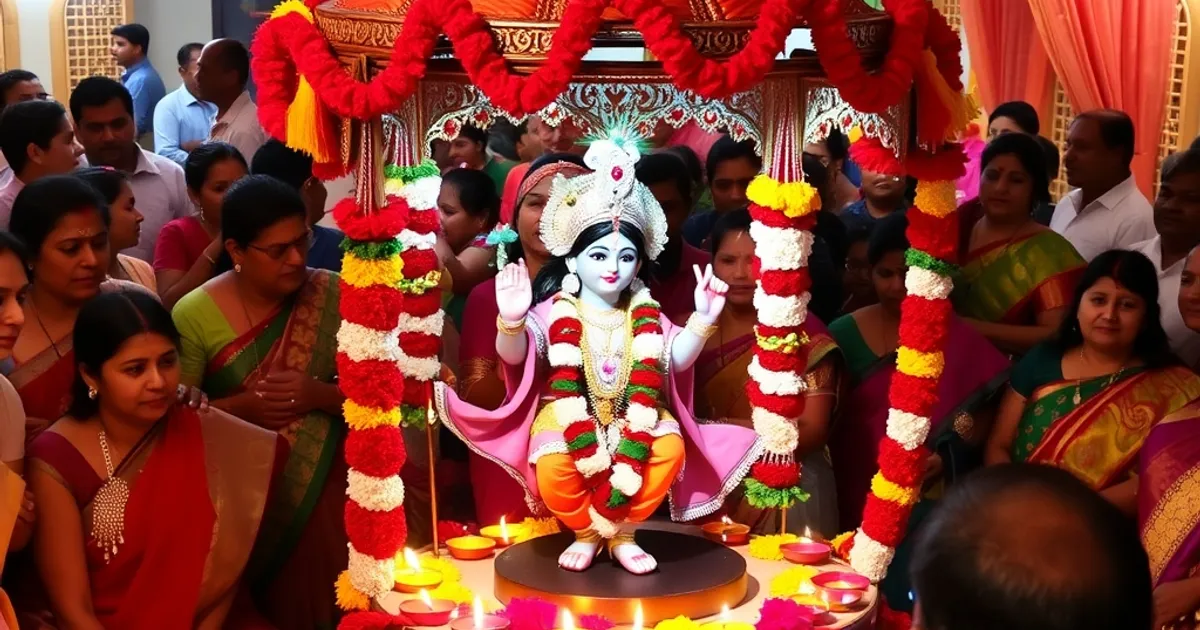
At midnight, a cradle ceremony (jhula) is performed for an idol of baby Krishna. The idol is bathed in panchamrit — a mixture of milk, curd, honey, sugar, and ghee — and then dressed and placed in the small decorated swing. The fast is broken with makhan-mishri (butter and sugar), sweets associated with Krishna's childhood. The atmosphere at a mandir midnight puja is distinctive: the crowd, the chanting, the moment of the clock striking twelve and the joy that breaks across the room.
For the Indian community in Cupertino, the practical challenge is finding a space large enough to host a proper midnight program. No dedicated temple is listed for Cupertino itself, which means families who want the full community experience travel to mandirs in Milpitas, Sunnyvale, San Jose, or Fremont. These temples regularly put together Janmashtami events that include bhajans, Dahi Handi re-enactments, classical dance performances, and prasad distribution. Attendance at popular Bay Area mandirs can run into the thousands on Janmashtami night, so arriving early matters.
Insider Tip: Many Bay Area temples open registration for their Janmashtami midnight puja in August — sometimes as early as the first week. Community WhatsApp groups and temple social media pages are the fastest way to catch registration announcements. Signing up in advance means a reserved spot rather than a long queue, and it gives the organizing committee better numbers for prasad preparation.
If you prefer a home celebration, the format is entirely flexible. Set up a small jhula using a decorated cradle or a hanging cloth swing. Place an idol or framed image of baby Krishna. Keep a diya lit through the evening, invite family and close friends for bhajans, and perform the abhishekam at midnight. A priest can be invited to conduct the full ritual if you prefer a guided puja.
The Full Panchang: Key Dates From July Through September
The complete calendar around Krishna Janmashtami 2026 gives Cupertino's Indian community a structured rhythm of observance:
- Ekadashi (Jul 24) — fast day, Vishnu worship
- Pradosh Vrat (Jul 26) — Shiva worship on the thirteenth lunar day
- Guru Purnima 2026 (Jul 28) — honor spiritual teachers; full moon
- Sankashti Chaturthi (Aug 2) — Ganesh worship on the waning moon
- Ekadashi (Aug 8) — Vishnu fast
- Pradosh Vrat (Aug 10) — Shiva worship
- Amavasya (Aug 12) — new moon, ancestor rites
- Nag Panchami 2026 (Aug 16) — serpent deity veneration
- Ekadashi (Aug 23) — Vishnu fast
- Pradosh Vrat (Aug 25) — Shiva worship
- Raksha Bandhan 2026 (Aug 27) — sibling celebration on the full moon
- Sankashti Chaturthi (Aug 31) — Ganesh worship
- Krishna Janmashtami 2026 (Sep 4) — the main event, midnight observance
- Pradosh Vrat (Sep 8) — Shiva worship
- Amavasya (Sep 10) — new moon, ancestor rites
- Ganesh Chaturthi 2026 (Sep 14) — Ganesha festival begins
That last date deserves attention. Ganesh Chaturthi 2026 arrives just ten days after Janmashtami. Bay Area celebrations for Ganesh Chaturthi can be elaborate — large community installations, daily aartis, and cultural programs over a ten-day period. For families planning to observe both Janmashtami and Ganesh Chaturthi fully, the first half of September is a continuous period of preparation and celebration.
Celebrating Without a Local Temple
No temples are listed in Cupertino specifically, but the Indian community here is well-connected through cultural organizations, neighborhood associations, and religious groups operating across the South Bay. Several paths are available:
South Bay mandirs — in Milpitas, Sunnyvale, San Jose, Livermore, and Fremont — are the primary destinations for large community events. Most of these temples have email lists and social media pages that announce programs well in advance. Following them in July gives families enough time to plan the September 4 trip.
Community cultural centers and Hindu cultural associations occasionally host programs that do not require a mandir. Janmashtami events featuring Bharatanatyam or Kathak performances, dramatic presentations of Krishna's life story, and devotional music are relatively common in the Bay Area and provide an alternative for families who prefer a cultural program over a strictly religious one.
Online live-streams have also become a genuine option. Major temples in India and across the US stream their Janmashtami midnight pujas, allowing families in Cupertino to participate in the atmosphere of a large gathering from their living rooms. The quality of production at larger mandirs has improved significantly, and the shared experience of watching the same puja as thousands of other viewers carries its own community feeling.
FAQ
When exactly is Krishna Janmashtami 2026? Krishna Janmashtami 2026 falls on September 4, 2026. The birth of Krishna is observed at midnight, so celebrations typically begin on the evening of September 4 and conclude in the early hours of September 5.
Are there temples in Cupertino for Janmashtami? No temples are currently listed in Cupertino. The nearest options are in Milpitas, Sunnyvale, San Jose, and Fremont. Check South Bay temple websites for program details and registration timelines.
How do I fast for Janmashtami? The traditional Janmashtami fast means abstaining from grains and most cooked food until midnight. Fruits, milk, and foods made from water chestnut flour are commonly consumed during the fast period. The fast is broken after the midnight ritual with panchamrit and sweets.
What is Dahi Handi? Dahi Handi is a tradition tied to young Krishna's fondness for stealing butter and curd. Participants form human pyramids to break a clay pot filled with curd, suspended at height. It is a popular feature at community Janmashtami events and draws enthusiastic participation from younger community members.
What comes right after Janmashtami in the calendar? Ganesh Chaturthi 2026 falls on September 14, just ten days after Janmashtami. For families observing both, the first half of September is a continuous stretch of festival preparation and celebration.
What is the significance of Guru Purnima 2026 for the season? Guru Purnima 2026 on July 28 opens the summer festival window. It is observed on the full moon of the Hindu month of Ashadha and is dedicated to honoring teachers — both spiritual gurus and, in broader practice, anyone who has guided learning or growth.
Bottom Line 🙏
Krishna Janmashtami 2026 on September 4 is the anchor event for Cupertino's Indian community through this late-summer festival season. With Guru Purnima 2026, Nag Panchami 2026, and Raksha Bandhan 2026 building toward it — and Ganesh Chaturthi 2026 arriving just ten days after — the weeks surrounding Janmashtami form one of the fullest stretches on the Hindu calendar. No local temple in Cupertino means some travel is required for larger community events, but home pujas, South Bay mandir programs, and live-streamed midnight observances from major temples offer multiple ways to mark the occasion with intention and community connection.