
Where to Play Garba & Dandiya in Frankfurt This Navratri
Where to Play Garba & Dandiya in Frankfurt This Navratri
TL;DR
- 🪔 Frankfurt's Indian community follows the Hindu festival calendar year-round, from Ekadashi to Purnima
- 🎉 Navratri is the festival season's peak, celebrated with Garba and Dandiya across community gatherings
- 🌕 Raksha Bandhan 2026 and Nag Panchami 2026 mark the late-summer run-up to the autumn festival season
- 🥁 Garba and Dandiya events are organized through Indian cultural associations, community groups, and temple networks
- 📅 Staying connected with Frankfurt's Indian associations from summer onwards is the most reliable path to events
Navratri arrives every autumn with nine nights of color, music, and the kind of communal energy that is hard to replicate in any other setting. For the Indian community in Frankfurt, it is the highlight of the festival calendar — the moment when Garba circles form, Dandiya sticks click together in rhythm, and the diaspora gathers to keep alive something that goes much deeper than a celebration. The festival is both a religious observance and a cultural anchor, a night — multiplied nine times — when questions of identity, belonging, and memory surface through movement and music.
This guide walks through the Hindu festival calendar as it unfolds in Frankfurt, how the Indian community marks the months leading up to Navratri, and how to find Garba and Dandiya events when October arrives.
The Hindu Festival Calendar in Frankfurt
Frankfurt's Indian community does not wait until October to start observing. The festival rhythm runs year-round, and the months between summer and Navratri are dense with their own occasions — lunar observances, seasonal fasts, and celebrations tied to specific deities and stories from the Hindu tradition.
Nag Panchami 2026 falls during the Shravan month, one of the most religiously significant months in the Hindu lunar calendar. Shravan is associated with Lord Shiva and is marked by fasting, prayer, and the observation of specific vrats throughout the month. Nag Panchami, dedicated to serpent deities, is observed across Maharashtra, Karnataka, Rajasthan, and other states, typically with milk offerings, home prayers, and the preparation of traditional sweets. For Indian families in Frankfurt, it is one of those dates that arrives quietly and is observed at home or at a local temple — a private moment in a calendar that will become much more public by October.
Raksha Bandhan 2026 follows in the same Shravan season and carries a different kind of energy. It is a celebration of the sibling bond — sisters tying rakhi threads on their brothers' wrists as a gesture of protection and affection — but in the diaspora, it has also become one of the occasions that draws the broader Indian community together. Cultural organizations in the Rhein-Main region organize Raksha Bandhan events with music, community meals, and programs that bring families out when proximity to home is not possible. For those who cannot be with their siblings in India, these gatherings carry a particular weight.
The lunar calendar marks Ekadashi — the eleventh day of each lunar fortnight — as a day of fasting and spiritual reflection for many practicing Hindus. The Ekadashi on August 9 is one of the recurring observances that punctuate the festival calendar with moments of quiet practice, observed individually or in small community prayer gatherings. Similarly, Pradosh Vrat on August 10 is a bi-monthly fast observed in honor of Lord Shiva, particularly significant for devotees who maintain a consistent prayer discipline across the months regardless of the larger festival season around them.
Amavasya on August 12 — the new moon day — is a time for ancestral rituals and remembrance. Amavasya observances are typically quiet, home-based affairs: prayers for departed family members, offerings, and a period of reflection. In Frankfurt, as in any diaspora setting, these dates connect people to a relationship with time and memory that crosses geography.
Purnima, the full moon, carries specific significance depending on the month. Guru Purnima honors spiritual teachers. Sharad Purnima in autumn is associated with Lakshmi and the harvest, and it falls close to Navratri. Each Purnima functions as a gathering point — temple prayer programs, cultural events, and community celebrations organized around the lunar calendar rather than the Gregorian one. In Frankfurt, Purnima observances are often the occasions when community members who might not see each other week to week come together in a shared space.
Sankashti Chaturthi, dedicated to Lord Ganesha and observed on the fourth day after each new moon, is another recurring date on the Hindu calendar that the Frankfurt Indian community maintains. Ganesha occupies a specific place in the festival season — it is Ganesh Chaturthi that opens the major autumn festival period in Maharashtra, and the thread running through Sankashti observances across the months builds toward that moment and the Navratri celebrations that follow.
Navratri & Garba Celebrations
Navratri translates as "nine nights," and each night carries its own deity and associated color. The festival spans nine days of worship dedicated to the goddess Durga in her nine forms, with Dussehra on the tenth day marking the symbolic victory of the divine over forces of destruction. Across India, regional celebrations differ considerably: Gujarat is known for its elaborate Garba traditions; West Bengal centers the festival on Durga Puja with large pandals and artistic installations; Maharashtra adds its own layer of community worship.
Frankfurt's Indian community brings that regional diversity with it. Families from Gujarat carry the Garba tradition; those from Maharashtra, Rajasthan, and other states add their own observances. The result during Navratri is a celebration that draws from multiple regional traditions while producing something distinctly diasporic — an expression of cultural identity adapted to life in Germany without losing its essential character.
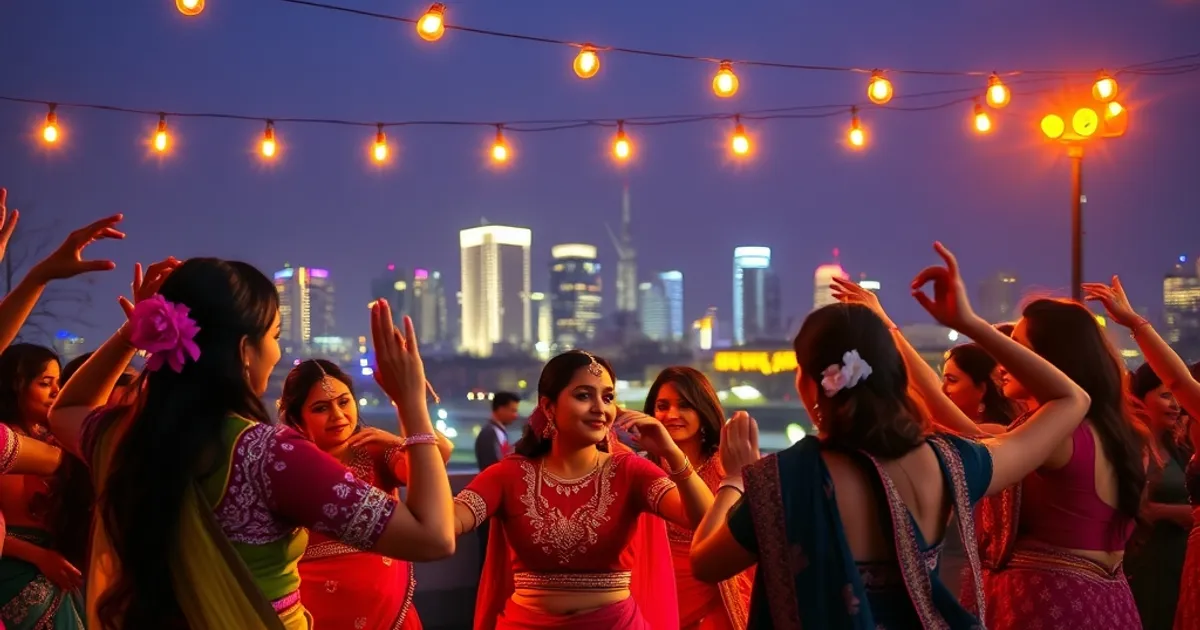
Garba is a circle dance performed in honor of the goddess, with participants moving in synchronized patterns around a central lamp or image of Durga. The dance has ancient roots, but contemporary Navratri Garba in diaspora settings typically blends traditional and newer choreographic forms, features elaborate traditional dress — chaniya choli for women, kediyu and churidar for men — and draws on music that ranges from classical Garba compositions to more contemporary arrangements. The circle itself is the point: it centers everyone equally, keeps the focus on the collective rather than the individual, and creates a rhythm that sustains itself through the night.
Dandiya Raas is performed in the later nights of Navratri, with pairs of dancers striking decorated sticks together in patterns that require coordination and timing. It is more immediately accessible to newcomers than the more structured Garba forms, and at community events in Frankfurt, stick sets are typically available and first-time participants are welcomed into the circles. The energy of Dandiya events tends to run higher as the evening progresses, which is why these later nights are particularly well-attended.
For the Indian diaspora in Frankfurt, Navratri events carry significance beyond entertainment. They are one of the few occasions when the community gathers at scale — when children born in Germany experience the festival culture their parents grew up with, when connections across regional communities (Gujarati, Maharashtrian, Rajasthani, Tamil, Kannada-speaking) temporarily dissolve into a shared space of celebration, and when the act of dancing together becomes something that carries cultural memory forward.
How to Find Events in Frankfurt
Frankfurt does not have a single central Indian community organization that coordinates all events. Finding Garba and Dandiya events during Navratri requires knowing which networks to watch.
The Hindu temple communities in the broader Rhein-Main region — which includes Frankfurt, Offenbach, Wiesbaden, and surrounding cities — are the primary anchors for religious observances throughout the festival calendar. Temple announcement boards, community WhatsApp groups, and social media pages maintained by Indian cultural associations are where event information typically circulates first, often weeks before it appears on public platforms.
The observances leading up to Navratri — Raksha Bandhan 2026 events, Nag Panchami 2026 gatherings, and the regular Purnima and Ekadashi prayer programs — are often organized through the same networks that coordinate Navratri events. Staying connected to those channels from the summer months means you receive advance notice and avoid the situation of finding out about a sold-out event after the fact.
Cultural associations rooted in the Frankfurt Indian community — including Gujarat-origin associations, Maharashtra Mandals, and pan-Indian cultural groups active in the Rhein-Main area — typically organize Navratri events at larger venues capable of accommodating a proper Garba circle. These are often ticketed events announced four to six weeks in advance, with traditional dress encouraged to maintain the festive atmosphere.
Community platforms like Desi.Net maintain listings for Frankfurt events and surface announcements as they are published. Social media groups for Indians in Frankfurt or across Germany more broadly are active sources when events are approaching. Searching for terms like "Frankfurt Navratri," "Garba Frankfurt," or "Dandiya Rhein-Main" will surface event announcements as October draws closer.
Insider Tip: The most reliable way to secure entry to Navratri Garba events in Frankfurt is to connect with the relevant cultural association before the festival — ideally around Raksha Bandhan 2026 in August. Many events fill their capacity early, and being on an association's mailing list means you receive advance notice before general announcements go out. Gujarat Samaj chapters and similar regional organizations in the Frankfurt and Rhein-Main area are natural starting points for making that connection.
FAQ
When is Navratri 2026? Navratri follows the Hindu lunar calendar and typically falls in October. The specific dates shift each year based on the lunar cycle; check the Hindu calendar for the 2026 Sharad Navratri dates once confirmed.
Do I need to be Hindu or Indian to attend Garba events in Frankfurt? Most community Garba and Dandiya events in Frankfurt welcome guests from outside the Indian community. Some temple-based observances may be more community-specific. Checking with the organizing association before attending is always a good approach.
What should I wear to Garba or Dandiya in Frankfurt? Traditional attire is encouraged and often expected. Women typically wear chaniya choli, the three-piece Gujarati outfit with a flared skirt. Men wear kediyu with dhoti or churidar. Many community events in Frankfurt accommodate those without traditional dress, but wearing it adds to the shared atmosphere of the evening.
What is the difference between Garba and Dandiya? Garba is a circle dance performed during the earlier nights of Navratri, centered on movement and devotion. Dandiya Raas involves pairs of dancers striking decorated sticks together and is typically performed during the later nights. Both are associated with Navratri and appear at most community events.
What other Indian festivals does Frankfurt celebrate before Navratri? The months leading to Navratri include Nag Panchami 2026, Raksha Bandhan 2026, Purnima observances, Ekadashi fasting days, Pradosh Vrat, Amavasya rituals, and Sankashti Chaturthi — all of which the Frankfurt Indian community observes through home practice, temple programs, and community gatherings.
Bottom Line 🎊
For Frankfurt's Indian community, the Navratri season does not arrive from nowhere. It is the culmination of a festival calendar that has already been in motion since summer — through Nag Panchami 2026, Raksha Bandhan 2026, Purnima gatherings, Ekadashi observances, Pradosh Vrat, Amavasya remembrances, and Sankashti Chaturthi prayers. By the time Garba circles form and Dandiya sticks come out in October, the community has already spent months building the connections that make those nine nights possible. Staying plugged into Frankfurt's Indian associations and cultural networks from the beginning of the season is the surest path to being part of it.