
Janmashtami 2026 in Hoboken: Events, Puja & Where to Celebrate
TL;DR 🎊
- Krishna Janmashtami 2026 falls on September 4, marking Lord Krishna's birth at the stroke of midnight
- Hoboken's Indian community is part of the broader NYC metro Desi network — one of North America's largest South Asian populations
- The festive season builds through Guru Purnima 2026 (Jul 29), Nag Panchami 2026 (Aug 17), and Raksha Bandhan 2026 (Aug 27) before Janmashtami arrives
- Expect midnight abhishek ceremonies, dahi handi traditions, and community kirtan gatherings
- Ganesh Chaturthi 2026 on September 14 keeps the energy going right after Janmashtami
Building Toward Janmashtami: The Summer Calendar
Krishna Janmashtami 2026 does not arrive without preparation. The Hindu calendar lays a path of observances through the summer months that brings the community together week by week, building devotional momentum toward the most beloved of Vaishnava celebrations.
The season opens with Guru Purnima 2026 on July 29 — a full moon day when students honor their teachers and devotees offer reverence to their spiritual guides. The day holds particular significance in traditions rooted in the guru-shishya parampara, and many families in Hoboken's Indian community mark it with special prayers and home offerings.
Nag Panchami 2026 follows on August 17, a day devoted to serpent deities across Hindu traditions. Milk offerings at home altars are the core observance. It falls within the sacred month of Shravana, the same month that yields Raksha Bandhan 2026 on August 27.
Raksha Bandhan 2026 deserves its own moment. This is the day when sisters tie rakhis — sacred threads — on their brothers' wrists, and families gather around shared meals and sweets. For Hoboken's Indian families spread across the tri-state area, it is one of the most actively celebrated dates on the late-summer calendar.
Then comes the main event: Krishna Janmashtami 2026 on September 4. Almost immediately after, Ganesh Chaturthi 2026 on September 14 keeps the festive arc going for another ten days.
Janmashtami in the NYC Metro: The Hoboken Advantage
Hoboken sits at the edge of Hudson County, separated from Manhattan by the Hudson River and connected by the PATH train and ferry. This geography gives Hoboken's Indian residents a meaningful advantage during festival season: the full depth of the NYC metro's South Asian cultural infrastructure is within easy reach.
The New York metropolitan area holds one of the largest South Asian populations outside the Indian subcontinent. Temples, mandirs, and cultural centers are spread across Jersey City, Flushing in Queens, Jackson Heights, Edison in Middlesex County, and dozens of other locations. Hoboken residents regularly make these trips for major celebrations, and Janmashtami is no exception.
Hoboken does not currently have a dedicated Hindu temple, but this is a practical detail rather than a limitation. The community's devotional life is distributed — across homes, rented community halls, and the major temple spaces reachable by car or transit in under an hour.
What Janmashtami Night Looks Like
The structure of a Janmashtami celebration has remained consistent across generations, adapted to the diaspora context without losing its core elements.
Devotees observe an upwas (fast) through the day of September 4. The fast is typically complete — no grains, no legumes — though variations exist based on family tradition and health needs. The purpose of the fast is to keep the body in a state of preparation for the midnight ritual, the culmination of the day's devotion.
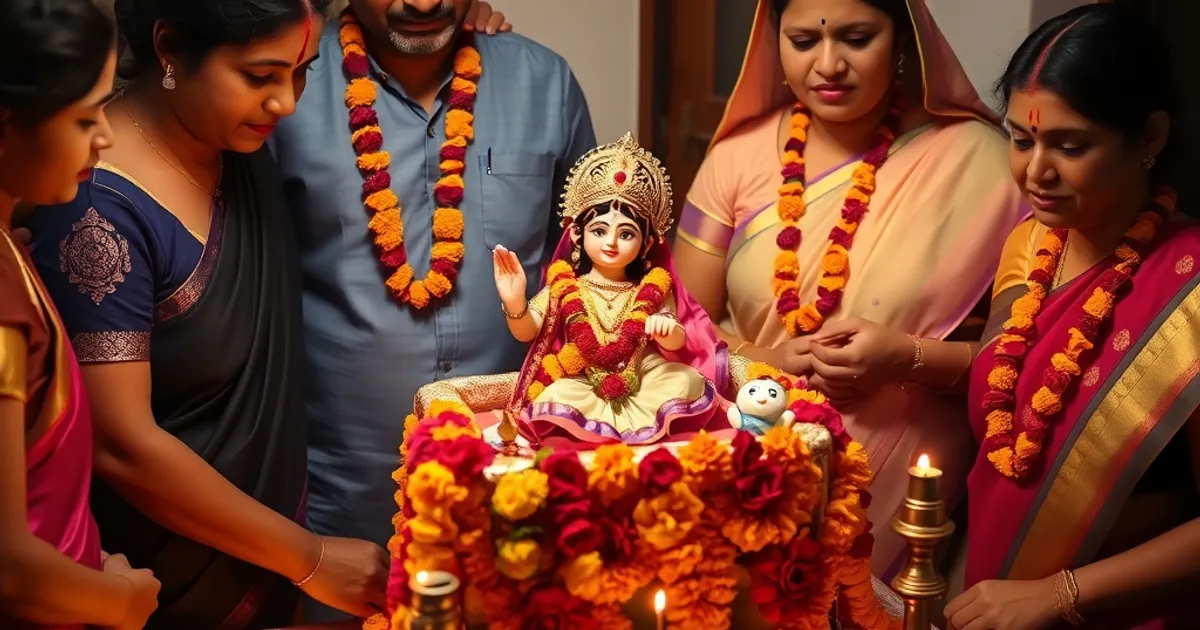
At midnight, the abhishek begins. A small Krishna idol — often Bal Gopal, the child form of Krishna — is bathed in panchamrit, a blend of milk, yogurt, honey, ghee, and sugar. Flowers and tulsi leaves are offered. Bhajans fill the room. The fast breaks with prasad that typically includes makhan (butter, deeply associated with Lord Krishna's childhood), mishri (rock sugar), and small sweets.
The home is decorated with a jhoola (cradle or swing) for the Krishna idol, adorned with flowers and colorful fabric. In community settings, the decorations can be elaborate — full stage setups with floral arches, lighting, and theatrical backdrops depicting the life of Krishna.
Dahi handi is another Janmashtami fixture in the NYC metro: groups build human pyramids to break a pot of curd suspended high in the air, enacting the young Krishna's legendary fondness for dairy. This tradition is driven particularly by the area's large Maharashtrian community.
Puja at Home: What You Need
For Hoboken families observing Krishna Janmashtami 2026 at home, the preparation is both practical and devotional. A clean, decorated puja space is the foundation. A framed image of Bal Gopal serves the ritual purpose just as well as a three-dimensional idol for families without one.
Shopping for puja supplies within Hoboken is limited — the city is compact and residential. Most community members head to Jersey City, particularly the Indian grocery stores along Newark Avenue, where dry goods and fresh puja items are available. Edison's Oak Tree Road corridor is the destination for those willing to make the longer drive and who want a wider selection of sweets, flowers, and decorative items.
Plan early if you want fresh marigolds or a well-crafted jhoola. Demand spikes sharply in the two weeks before Janmashtami.
Insider Tip: ISKCON centers across the NYC metro hold Janmashtami programs that are open to anyone who wants to attend. These events feature theatrical Ras Lila performances, extended kirtan, and the midnight abhishek ceremony. Programs often run past 2 AM and draw thousands of attendees. Announcements go up a few weeks in advance — and if you're driving, arrive early for parking.
FAQ
When is Krishna Janmashtami 2026? Krishna Janmashtami 2026 is September 4, 2026. The central ritual — the abhishek and breaking of the fast — takes place at midnight.
Is there a Hindu temple in Hoboken? There is no Hindu temple within Hoboken. The nearest options are in Jersey City and across the NYC metro area in New York and New Jersey.
What does the Janmashtami fast involve? Most people observe a Nirjala (waterless) or Phalahar (fruit and dairy) fast throughout the day, breaking it only after the midnight puja with panchamrit prasad.
What is dahi handi? Dahi handi is a Janmashtami tradition in which groups form human pyramids to break a suspended pot of curd. It celebrates the young Krishna's fondness for butter and curd. It is most actively practiced by Maharashtrian communities.
What other events lead up to Janmashtami? Guru Purnima 2026 (Jul 29), Nag Panchami 2026 (Aug 17), and Raksha Bandhan 2026 (Aug 27) are the key milestones. Ekadashi fasting days and Pradosh Vrat also fall regularly through July, August, and September.
What comes after Janmashtami in the 2026 calendar? Ganesh Chaturthi 2026 on September 14 is the next major festival, starting a 10-day celebration of Lord Ganesha.
Bottom Line 🙏
Krishna Janmashtami 2026 on September 4 is the centerpiece of a summer-long arc of Hindu observance for Hoboken's Indian community. Starting from Guru Purnima 2026 in late July and running through Ganesh Chaturthi 2026 in mid-September, the season offers sustained opportunities for devotion, community gathering, and celebration. Hoboken's proximity to the NYC metro puts every major temple and cultural event within reach — the community may be compact, but its connections run deep.