
Weekend Activities for Desi Kids in Plainsboro
TL;DR
- This month's Hindu observances in Plainsboro are genuine learning experiences for Desi kids of all ages 🌟
- Guru Purnima 2026 (July 29) gives children a concrete reason to honor teachers in their own lives
- Sankashti Chaturthi (August 2) introduces kids to Ganesha through prayers, stories, and simple offerings 🐘
- Nag Panchami 2026 (August 17) opens a window into Hindu mythology that kids with curious minds tend to love
- Participating in even two or three of these observances builds a heritage connection no classroom can replicate
Making the Hindu Calendar Work for Desi Kids in Plainsboro
For Desi families in Plainsboro raising children in a largely non-South Asian environment, the Hindu lunar calendar offers something genuinely valuable: meaningful touchstones throughout the year that connect kids to their heritage, their extended family, and a community larger than themselves. The challenge, of course, is making those touchstones accessible and engaging for children at various ages and stages.
This month is unusually rich for that purpose. From late July through mid-August, the calendar brings Pradosh Vrat, Guru Purnima 2026, Purnima, Sankashti Chaturthi, Ekadashi, Amavasya, and Nag Panchami 2026. Each of these observances carries stories, traditions, and opportunities for children to participate rather than simply observe. The following guide walks through each one with a family and kids angle — what it is, what it teaches, and how to bring it to life for the children in your household.
Festivals Through a Child's Eyes: What Each Observance Offers
Pradosh Vrat (July 26, July 27, August 10) — Stories of Lord Shiva
Pradosh Vrat is a devotional fast for Lord Shiva observed on the Trayodashi (thirteenth lunar day) of each lunar fortnight. The name refers to the dusk period — a transitional window around sunset — when prayers honoring Shiva are traditionally performed. This cycle has the unusual quality of offering Pradosh Vrat on both July 26 and July 27 before the observance returns on August 10, giving families three separate evening entry points.
For younger children, Pradosh Vrat is a natural opening to introduce Shiva's stories. Why does Shiva have a crescent moon in his hair? Why does he carry a trident? These questions have answers rooted in mythology that children find genuinely fascinating. The fast is typically for adults, but children can sit alongside parents or grandparents during the evening puja and absorb the stories behind the prayers.
Guru Purnima 2026 (July 29) — Honoring Teachers Your Kids Already Have
Guru Purnima 2026 falls on July 29, coinciding with Purnima (the full moon). For children, this may be the single most relatable Hindu observance of the year: it is explicitly about honoring teachers.
Every child in Plainsboro has teachers — at school, at Bharatanatyam class, at chess club, at karate practice, with the music teacher who helped them learn the tabla. Guru Purnima is a prompt to recognize all of them. Desi families can use July 29 to help children write a sincere thank-you note to a teacher who made a difference, or call and thank a grandparent who taught them something meaningful about life or language.
Beyond the personal dimension, Guru Purnima carries the tradition of Vyasa — the sage credited with composing the Mahabharata and organizing the Vedas — who is said to have been born on this full moon. Older children will find the Mahabharata rich territory: the story of five brothers, a kingdom, and a war that contains some of the most compelling characters in world literature. A brief family read-aloud from an illustrated children's Mahabharata on the evening of July 29 gives the observance a lived, story-based texture. The full moon itself is a draw for children — spend a few minutes outside on the Purnima evening and let the moon be part of the conversation about why this night is special.
Sankashti Chaturthi (August 2) — Ganesha for Every Age
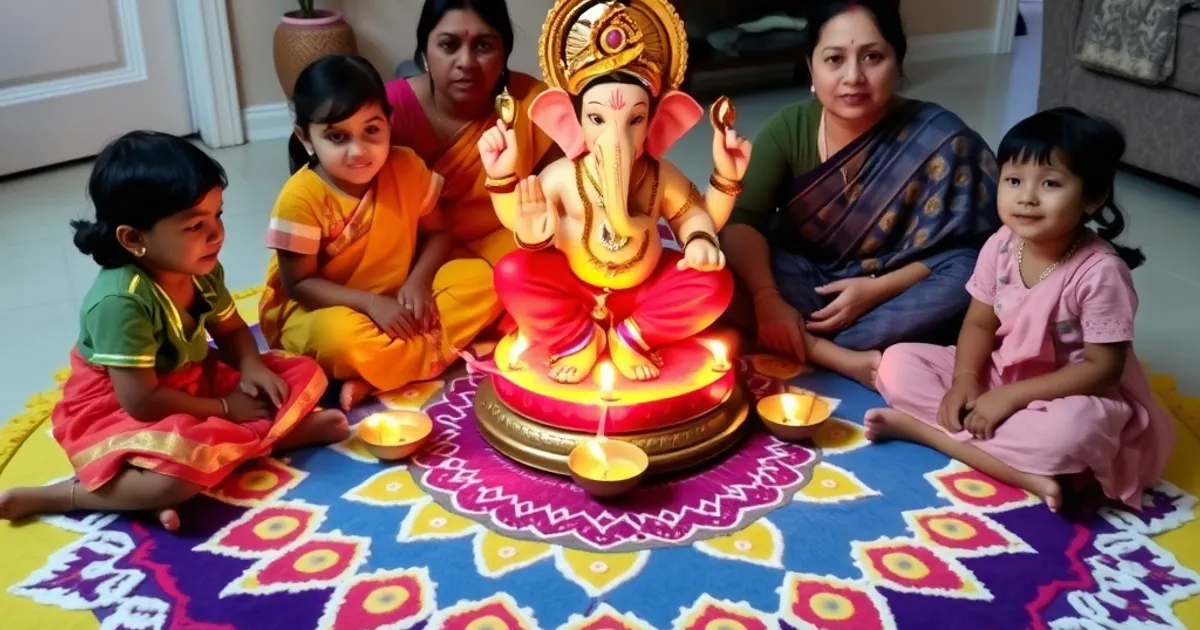
Of all the observances this month, Sankashti Chaturthi is probably the one most naturally suited to children. Ganesha — the elephant-headed deity who removes obstacles and brings wisdom — is beloved across ages, and particularly accessible to kids who respond to his joyful, distinctive form.
Sankashti Chaturthi falls on August 2. The traditional observance involves fasting through the day and breaking the fast after the moon rises, following prayers to Ganesha. For children, participation can mean making a simple offering (a flower, or modak and laddoo if the family prepares them), drawing or coloring an image of Ganesha, or listening to the story of how Ganesha came to have an elephant head. Older children might enjoy learning the Ganesh Chalisa or a simple Ganesha mantra to recite at the evening puja. For very young children, the visual richness of Ganesha's image — the elephant head, the round belly, the mouse vehicle, the broken tusk — is itself an entry point into asking questions.
The storytelling richness of Ganesha makes Sankashti Chaturthi one of the most effective entry points into Hindu practice for Desi kids building their grounding in the calendar.
Ekadashi (August 8) and Amavasya (August 12) — Discipline and Memory
Ekadashi, the eleventh lunar day, falls on August 8. For older children and teenagers, it can be framed as a lesson in intentional self-discipline — choosing to simplify diet, set aside distractions, and bring focus to one day. Even a modified version (a fruit-only day, a screen-free afternoon) connects the concept without requiring a full adult fast.
Amavasya — the new moon on August 12 — carries a different quality: ancestor remembrance. For children who may never have met great-grandparents, this can be a family memory day. Bring out photographs, tell stories about their lives, and light a lamp in their honor. Children who know their family history carry that knowledge forward.
Nag Panchami 2026 (August 17) — Mythology, Nature, and Curiosity
Nag Panchami 2026 arrives on August 17, the festival of serpent veneration in Shravan. For children, this opens one of Hindu mythology's most compelling threads: snakes are divine in Hindu cosmology — Shiva wears the serpent Vasuki, Vishnu rests on Ananta Shesha, and the goddess Manasa commands an entire serpent kingdom. Nag Panchami combines reverence for these mythological beings with a real-world lesson about not harming snakes, particularly during monsoon season.
Children who love animals or mythology are often captivated by the naga tradition. A Nag Panchami evening could include reading a naga story together, visiting a temple where a naga idol is consecrated, or discussing why cultures across the world revered serpents.
Insider Tip: If you want this month's observances to actually stick with your kids rather than blur together, pick one or two rather than trying to participate in everything. Guru Purnima 2026 and Sankashti Chaturthi are the strongest starting points for families with younger children. Both have clear, memorable stories and activities kids can do themselves — not just watch. For teenagers, Ekadashi and Nag Panchami 2026 offer more room for reflection and independent engagement.
FAQ
How do I make Guru Purnima 2026 meaningful for my child? Connect the day to your child's actual teachers. Help them write a thank-you note, read a Mahabharata story together, and go outside on the full moon evening of July 29 to mark the occasion.
Are Sankashti Chaturthi rituals safe for children to participate in? Yes. Children can join the evening puja, make simple offerings, and participate in prayers to Ganesha on August 2 without following the adult fasting regimen.
What is a child-friendly way to explain Nag Panchami 2026? Frame it as a day when Hindus honor the sacred serpents of mythology — the divine nagas who appear in the stories of Shiva and Vishnu — and as a reminder to respect snakes in the natural world.
What is Amavasya? Amavasya is the new moon day, observed on August 12. For children, it can be a family memory day — a moment to honor grandparents and ancestors through photographs and shared stories.
Can kids fast on Ekadashi? A full Ekadashi fast is typically an adult practice. For children and teenagers, a modified version — a simpler diet for the day or a screen-free afternoon — introduces the concept of intentional restraint without requiring a full fast.
Bottom Line
Plainsboro's Desi families have a meaningful set of observances to work with this month. Pradosh Vrat, Guru Purnima 2026, Purnima, Sankashti Chaturthi, Ekadashi, Amavasya, and Nag Panchami 2026 each offer a different lens through which children can engage with their heritage: Shiva stories at dusk, gratitude toward real teachers, Ganesha devotion through prayer and drawing, ancestral memory by lamplight, and the mythological wonder of divine serpents. For Desi kids growing up in Plainsboro, participating in even a few of these observances builds a living connection to their background that stays with them in ways a classroom lesson simply cannot replicate. Make the evenings count, tell the stories, and let the calendar do what it has always done: mark time in a way that carries meaning.