
Desi Things to Do in Tellicherry (July 2026)
TL;DR
- 🌊 Tellicherry (Thalassery) is a compact Malabar port town with a fort, a famous biryani, and a circus academy unlike anything else in Kerala
- 🎪 The Thalassery Circus Academy has trained performers for India's major touring troupes since the 1950s — and you can visit
- 🪔 Guru Purnima 2026 (Jul 29) and Nag Panchami 2026 (Aug 17) are the season's major communal observances, both worth timing a visit around
- 🍚 Thalassery biryani is made with kaima rice — a short-grained local variety — and is categorically different from anything called biryani elsewhere
- 🕌 The town's layered history (Malabar, British East India Company, Arab trading routes) makes its lanes worth walking slowly
Thalassery in Late July and August
Tellicherry — the name most people from here still use, though the official transliteration is Thalassery — sits on the northern Malabar coast, roughly midway between Kozhikode and Kannur. It is not a large town, but it holds an unusual concentration of history and texture for its size: a British-built fort on a sea-facing promontory, a famous biryani that has its own rice variety, a circus school that produced performers who toured across the country for decades, and a seafront that locals treat as an extension of their living rooms.
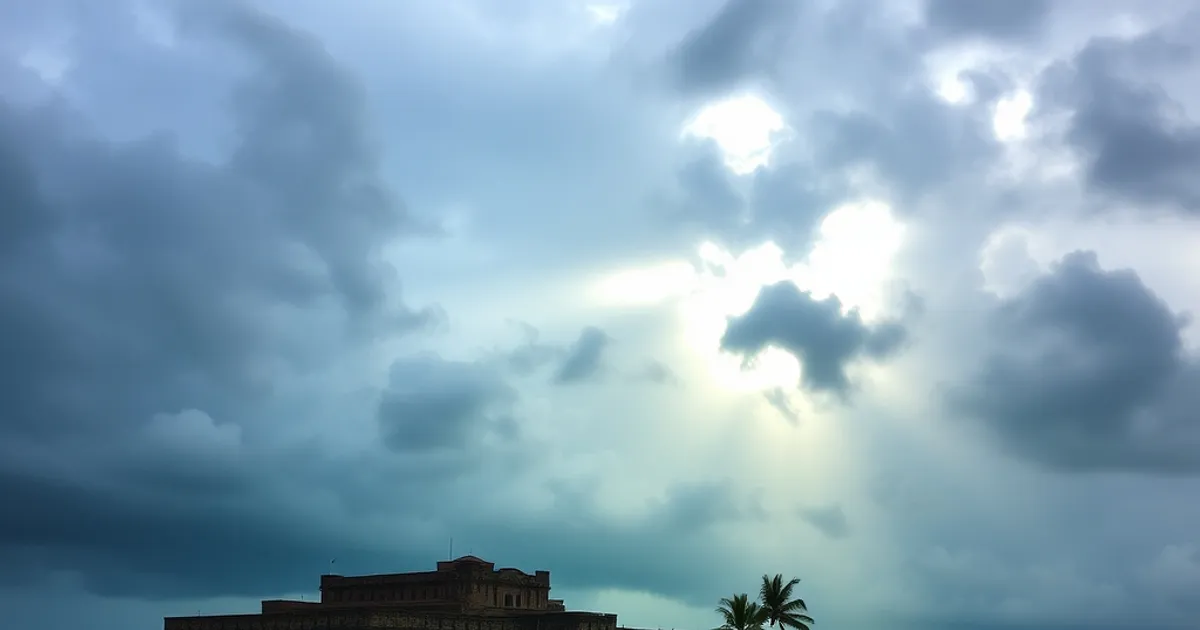
Late July and August are deep monsoon months in Malabar. The sea comes in hard and dramatic, the air carries the smell of rain and pepper and fish, and the pace of daily life settles into something slightly slower than the dry-season rhythm. For visitors with family connections here, or for those willing to travel outside peak season, this is a good time to be in Tellicherry — not polished, but real.
What to Do in Tellicherry
The fort: Thalassery Fort was built by the British East India Company in the early 18th century. The structure itself is relatively modest — it was a trading post fortification, not a military citadel — but the setting is exceptional. The fort sits on a small headland overlooking the Arabian Sea, and during the monsoon the waves arrive with enough force to make the stone walls feel relevant again. The area around the fort, with its cannon emplacements and unobstructed sea views, is worth an unhurried morning or late afternoon. Entry is straightforward and the site is not crowded in the off-season.
The Circus Academy: Thalassery has a specific claim to the history of Indian circus that is not replicated anywhere else in Kerala. The circus school here — connected to the broader tradition of Kerala's circus families — has been training acrobats, trapeze artists, and tightrope walkers since the mid-20th century. The major circus companies that toured across India for generations sourced much of their talent from this region. Whether you can catch a training session or a scheduled performance depends on the school's schedule when you arrive, but the tradition itself is visible in the culture of the town in a way that is worth understanding. This is not a tourist attraction — it is a living practice.
The old bazaar: Tellicherry was a significant node in the Malabar spice trade. Pepper, cardamom, and dried fish passed through this port for centuries before the East India Company arrived and after it left. The old bazaar lanes still carry something of that commercial history — the goods are different now, but the density of the market, the early-morning activity, and the layered architecture of the trading town remain. Walking the bazaar in the morning, before the heat and humidity climb, is the best way to understand how the town actually functions.
The seafront and evening life: On evenings when the weather permits, Tellicherry's seafront fills with people in the way that South Asian coastal towns tend to manage but that most cities elsewhere do not. Families, groups of young men, older couples, vendors — the seafront works as public space in a way that feels genuinely communal rather than designed.
The Calendar: Observances This Season
Guru Purnima 2026 (Jul 29) falls toward the end of July. Temples across the Malabar coast observe this day — honoring teachers and knowledge lineages — with early morning pujas and community gatherings. Families who are in Tellicherry during this period will find temple activity concentrated in the morning hours.
Sankashti Chaturthi (Aug 02) arrives a few days later. Ganesha temples see increased footfall for the fast and the moonrise observation. In a coastal town, watching the moon rise over the sea on Sankashti Chaturthi has a particular quality.
Ekadashi (Aug 09) falls on a Sunday. Fasting households keep the day quietly, with temple visits in the early morning. The specific foods prepared for Ekadashi vary by family tradition, but the day has a consistent character of restraint and attentiveness.
Amavasya (Aug 12) is the new moon — a day for ancestral prayers across Hindu traditions. In Tellicherry, a town with layers of family history stretching back through multiple eras of trade and migration, Amavasya carries a particular weight for those with deep local roots.
Nag Panchami 2026 (Aug 17) falls on a Sunday and is one of the more locally distinctive observances on the Malabar calendar. Naga worship in Kerala centers not primarily on large temples but on the sarpa kavu — the sacred serpent groves attached to older family properties and community spaces. These groves are a specifically Malabar feature of Nag Panchami observance that distinguishes the local form from how the day is celebrated in other parts of the country. If you have access to a family home with a sarpa kavu, this is the day to visit it.
The Biryani and the Food
Thalassery biryani deserves serious attention. It is prepared with kaima rice — a short-grained, distinctly fragrant variety grown in northern Kerala — rather than the long-grained basmati that defines Mughal-derived biryani styles. The preparation method, spice balance, and layering approach are also specific to the region. The result is a biryani with a different texture, a different fragrance, and a different relationship to the meat than anything the Hyderabadi or Lucknowi traditions produce. Several restaurants in town have been serving it across generations.
Beyond the biryani, the street food around the bus stand and market areas runs deep: pathiri (thin rice flour flatbreads), mussels fried in the local style, unniyappam, and a range of fish preparations that reflect the fishing activity of the coast. Breakfast at a local tea shop — strong black tea and something fried — is one of the more underrated pleasures of a Tellicherry morning.
Insider Tip: Kaima rice — the short-grained variety used in Thalassery biryani — is occasionally available in local grocery stores and rice shops. If you are traveling out of Tellicherry to another city, or heading back to somewhere abroad, picking up a kilogram of kaima rice along with the specific biryani masala blends that local cooks use is among the more practical things you can bring home. It travels well and actually replicates something of the dish in a different kitchen, which most culinary souvenirs do not manage.
FAQ
When is the best time of year to visit Tellicherry? October through February, when the monsoon has passed and the sea is calm. July and August bring heavy rainfall and rough seas. Families visiting relatives come regardless of season, and the town is fully functional through the monsoon — but first-time visitors should know that the weather will be wet.
What makes Thalassery biryani different from other biryanis? The primary distinction is kaima rice — shorter-grained and more fragrant than basmati, with a different cooking behavior and a finished texture that does not resemble Mughlai or Hyderabadi styles. The spice profile also reflects the Malabar coast's own spice traditions rather than the Persian-influenced Mughal culinary canon.
Is there a specific temple in Tellicherry associated with Nag Panchami? Naga worship in Kerala is organized around sarpa kavu — sacred serpent groves — rather than large public temples. These groves belong to older family properties and smaller community spaces. Observances there are typically accessible through family or community connections rather than as open public events.
How far is Tellicherry from Kozhikode and Kannur? Kannur is approximately 20 kilometers south — about 30 minutes by road. Kozhikode (Calicut) is roughly 70 kilometers south, about an hour to ninety minutes depending on traffic. Both cities have airports; Kannur International Airport is the closest.
Bottom Line
Tellicherry is not set up for tourism in the conventional sense, and the monsoon months are not peak season. But for people with a reason to be here — family, history, or a genuine interest in a Malabar coastal town that carries its layers without performing them — late July and August offer real substance. Guru Purnima, Sankashti Chaturthi, Ekadashi, Amavasya, and Nag Panchami come in quick succession, giving the weeks a calendar-anchored rhythm. Add the biryani, the fort, the circus school, and the particular atmosphere of Malabar in the rains, and you have more than enough reason to stay a full week.