
Janmashtami 2026 in West Chester: Events, Puja & Where to Celebrate
Krishna Janmashtami 2026 in West Chester: How Second-Generation Indian/Desi Americans Observe the Midnight Birth
TL;DR 🌙
- Krishna Janmashtami 2026 falls on Thursday, September 4, 2026 — a date with deep cultural and religious significance for Indian/Desi families and second-generation South Asian Americans in West Chester and the greater Philadelphia corridor
- For many who grew up in America, Janmashtami is the festival of strongest childhood memory: midnight Aartis, dressing as Krishna, breaking a day-long fast with panchamrit at 12 AM
- The full summer season runs from Guru Purnima 2026 (July 29) through Ganesh Chaturthi 2026 (September 14), with Janmashtami as the devotional and cultural peak
- West Chester sits roughly 25 miles southwest of Philadelphia, within reach of one of the most established South Asian communities on the East Coast — temples, cultural organizations, and Indian/Desi retail infrastructure are accessible
- The jhula (cradle) ceremony, bhajan singing, and the midnight Aarti are the three elements second-generation families most consistently report as essential to Janmashtami's meaning
Krishna Janmashtami 2026 in West Chester: A Festival in American Soil
Krishna Janmashtami 2026 arrives on September 4, 2026. For Indian/Desi families in West Chester, Pennsylvania — a borough in Chester County, about 25 miles southwest of Philadelphia — this date arrives differently depending on which generation of the family is receiving it.
For parents and grandparents who grew up in India, Janmashtami is inseparable from sensory memory: the scent of jasmine and incense at a neighborhood temple, the sound of a crowd counting down to midnight in Hindi or Gujarati or Telugu or Marathi, the specific press of bodies in a small room when the Aarti finally breaks. For their children and grandchildren who grew up in Chester County, the festival is something different and something more. It is one of the clearest annual points of contact between who they are as Americans and who they are as inheritors of a specific, irreplaceable cultural and spiritual tradition.
The Philadelphia metropolitan area has one of the most established South Asian communities in the United States. Indian immigrants began arriving in the Philadelphia region in significant numbers in the 1970s and early 1980s, and the second generation that grew up in that founding cohort is now well into adulthood — many raising a third generation in suburban communities including West Chester. The institutions built by the first generation — temples, cultural associations, language schools, Indian grocery corridors — are now fully available to families who did not have to build them themselves.
The Second-Generation Experience: Growing Up Janmashtami in the Philadelphia Suburbs
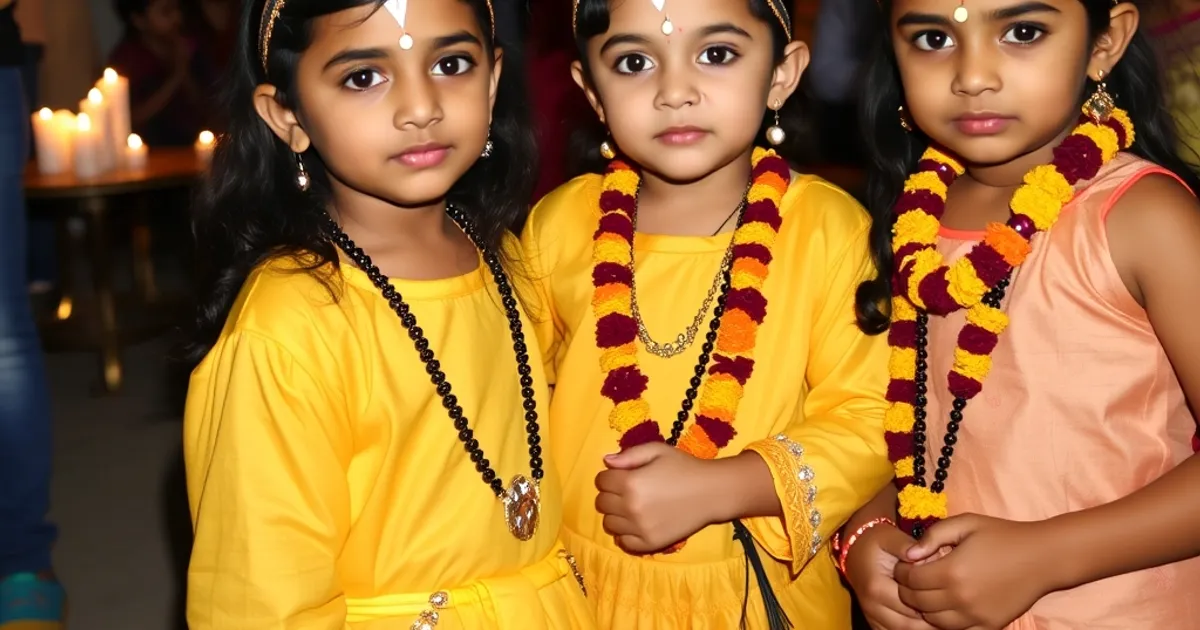
If you are a second-generation Indian American who grew up in West Chester or the surrounding Chester County area, Janmashtami in your childhood probably looked something like this: a Thursday evening in late summer when your mother dressed you in yellow and affixed a peacock feather to your hair, a drive to a temple or community center already crowded with families you recognized from school or the neighborhood, hours of bhajans you half-understood and fully felt, and the countdown to midnight that — even at age twelve, even after falling asleep on a folding chair — felt genuinely important in a way that was hard to explain to friends who had not been there.
That experience is not trivial. It is, for many second-generation South Asian Americans, the most durable single memory connecting them to their parents' cultural world. The festival calendar observed in diaspora communities is not identical to the one observed in India — it is adapted, compressed, and shaped by American rhythms — but the core of Janmashtami's midnight structure has largely held across the Atlantic crossing. You fast (or try to), you gather, you sing, you wait, and at midnight something arrives.
The third-generation challenge is sharper and more immediate. For South Asian American children growing up in West Chester today, Janmashtami competes with soccer schedules, school night routines, and the general gravitational pull of mainstream American childhood. The Indian/Desi cultural organizations and temples that organize Janmashtami programs in the greater Philadelphia area are doing something consequential when they put a midnight Aarti on the calendar and fill a room with families to observe it. The midnight gathering is not just ritual. It is an annual decision, made visible: we are still here, we still observe this, this is who we are.
Insider Tip: For second-generation Indian/Desi families hosting Janmashtami at home in West Chester for the first time, begin with the jhula ceremony rather than trying to replicate a full temple program. You need a small cradle — available at Indian/Desi religious supply stores in the Philadelphia area — a Bal Gopal idol or image, tulsi leaves, and the five ingredients for panchamrit (milk, curd, honey, ghee, sugar). At midnight, the group rocks the cradle while singing "Nand Gher Anand Bhayo" together. The song takes five minutes to learn; its communal performance at midnight is among the most emotionally resonant things you can do in a room full of people you love.
The Story the Festival Tells
Understanding what Janmashtami actually commemorates makes the rituals legible in a way that attendance alone does not always deliver, particularly for second and third-generation participants raised with partial religious education.
Krishna's birth is not a simple nativity story. He was born in a prison in the city of Mathura, the eighth child of Devaki and Vasudeva, who had been imprisoned by Devaki's tyrant brother Kamsa after a prophecy told him that this eighth child would bring about his end. The night of the birth, the guards fell into a supernaturally deep sleep, the prison doors swung open of their own accord, and Vasudeva carried the infant across a flooding, nighttime Yamuna River to safety in the village of Gokul — the river miraculously parting to let them pass.
The darkness of the night, the secrecy of the birth, the river crossing, the arrival under impossible circumstances: these are not decorative details. They are the structural content of the story. The Janmashtami fast re-enacts the hardship and vigil. The midnight hour re-enacts the birth. The jhula rocks the infant safe in the world. For second-generation Indian/Desi Americans in West Chester who may have grown up hearing this story without its full context, returning to it as adults often produces a reorientation toward the festival — what had felt like an inherited obligation reveals itself as a story of remarkable depth.
The Full Festival Season: July Through September 2026
Janmashtami arrives within a dense summer and early autumn calendar that Indian/Desi families in West Chester navigate alongside American school years, professional schedules, and suburban logistics.
Guru Purnima 2026 opens the season on July 29, a full moon day for honoring teachers and spiritual guides — observed with temple visits and expressions of gratitude. Nag Panchami 2026 follows on August 17 with offerings to serpent deities for household protection. Raksha Bandhan 2026 arrives on August 27, bringing siblings together across West Chester homes and across international video calls for the rakhi ceremony that crosses all regional and linguistic lines.
Regular lunar observances — Pradosh Vrat on July 26/27, August 10, August 25, and September 8, along with Sankashti Chaturthi on August 2 and August 31 — keep the devotional rhythm active between the major events. By the time Krishna Janmashtami 2026 arrives on September 4, observant families have been living in a heightened festival register for more than a month. Ten days later, Ganesh Chaturthi 2026 on September 14 carries the season forward.
For West Chester families, September 4 falling on a Thursday means the midnight celebration extends into a regular Friday school morning. Many Indian/Desi families plan ahead: some arrange a late arrival at school, others take a planned Friday absence, and some keep the celebration on the shorter side to preserve a reasonable bedtime. The point is to plan rather than to improvise.
FAQ
What does Janmashtami mean for someone who grew up Hindu but is not actively religious? Many second-generation South Asian Americans observe Janmashtami primarily as a cultural practice. The community gathering, the music, the midnight ritual, and the family connection carry meaning that does not require formal religious belief to be genuine.
What do children wear to Janmashtami events? Children are traditionally dressed as young Krishna — yellow dhoti or kurta, peacock-feather crown, small flute. Indian/Desi stores in the Philadelphia area stock these costumes from mid-August. Any yellow outfit works for children who prefer a looser interpretation.
What is the significance of yellow on Janmashtami? Yellow (pitambari) is the color most associated with Krishna, who is depicted in yellow robes. Wearing yellow to Janmashtami events is an expression of devotion and identification with him — widely practiced but not strictly required.
Are Indian/Desi temple events in the Philadelphia area open to non-Hindu guests? Most temples in the Philadelphia metro area welcome respectful visitors. Dress conservatively, remove footwear, and follow the lead of those around you.
How long do community Janmashtami programs typically run? Most programs begin around 7 PM and run through midnight and a short while beyond. Some include cultural performances, bhajan competitions, or stage programs before the midnight Aarti.
Bottom Line
Krishna Janmashtami 2026 on September 4 carries a particular weight for second-generation Indian/Desi Americans in West Chester and the greater Philadelphia area. It is simultaneously a religious festival, a cultural practice, and an annual act of transmission across generations — a midnight gathering that says something about who a community chooses to be in America. From Guru Purnima 2026 in late July through Ganesh Chaturthi 2026 in mid-September, the summer holds a full devotional season. Janmashtami, arriving at its center, is where that season becomes most fully itself.