
Onam 2026 in Pune: Events, Puja & Where to Celebrate
TL;DR
- Onam 2026 is the great Kerala harvest festival, with Thiruvonam landing in the August–September window 🌸
- Pune's Malayali community marks the occasion with elaborate pookkalam flower carpets, the grand sadhya feast, and cultural evenings
- Temples including Iskcon Temple and Sri Balaji Mandir serve as community anchors during the broader festival season
- The festival runs over ten days, building from Atham all the way to Thiruvonam — Pune families observe each stage at home and together
- September in Pune is rich with celebrations: Krishna Janmashtami on September 4 and Ganesh Chaturthi on September 14 bookend the Onam period 🪔
Onam in Pune: When Kerala Travels to Maharashtra
There is a particular kind of nostalgia that shapes how festivals work in migrant communities. For Malayali families who have built their lives in Pune — the engineers, doctors, IT professionals, academics, and entrepreneurs who came from Kerala and stayed — Onam is not merely a calendar event. It is the annual act of remembering: the smell of freshly picked flowers, the geometry of the pookkalam in the courtyard, the weight of a full sadhya served on banana leaves.
Onam commemorates the annual return of the mythical King Mahabali, a beloved ruler whose reign over Kerala is said to have been a golden age of abundance and justice. Each year, on Thiruvonam, the tradition holds that Mahabali visits his people. The flowers are laid out to welcome him. The feast is prepared to honor him. The joy is real.
For the Malayali community in Pune, this story takes on extra resonance — because like Mahabali, they too travel back in spirit, even when they cannot travel back in body.
The Ten Days: How Onam Builds
Onam is not a single-day affair. It runs for ten days, from Atham to Thiruvonam, and each day has its own character.
The Pookkalam: A Living Carpet
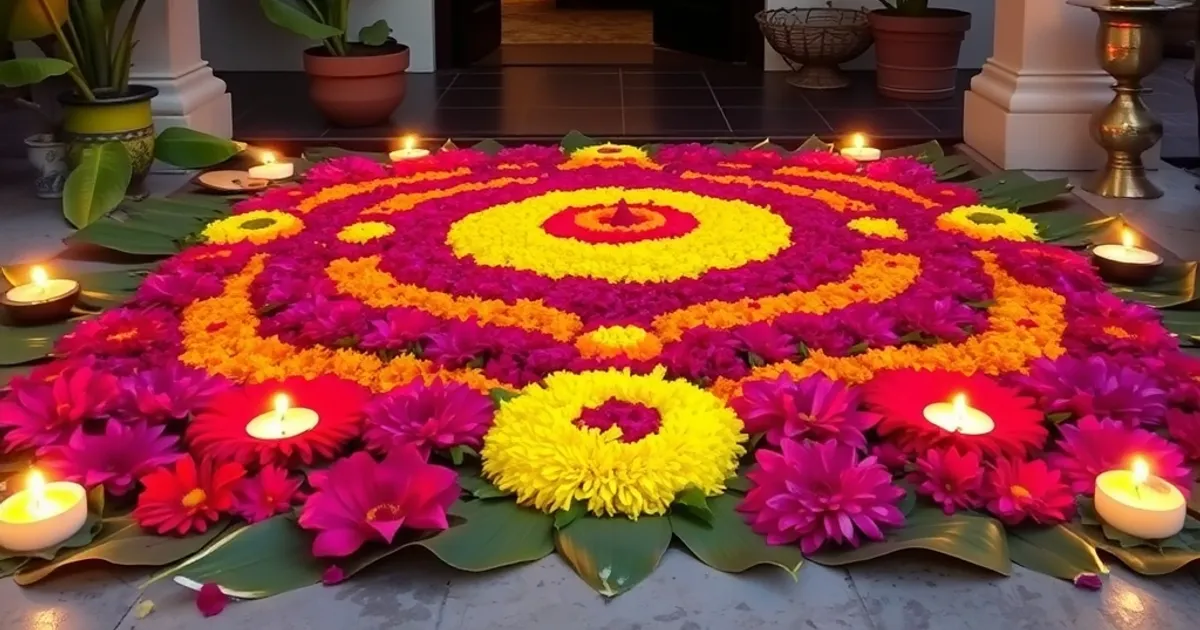
The most visible sign of Onam in any Malayali household in Pune is the pookkalam — the intricate flower rangoli that grows in the entrance of the home, layer by layer, over the ten days of the festival. On Atham, the first day, a small ring of flowers is placed. Each subsequent day adds another ring, a new pattern, a new set of colors. By Thiruvonam, the pookkalam can be several feet across, a riot of marigolds, chrysanthemums, jasmine, and whatever seasonal blooms the local markets carry.
Malayali families in Pune often make a morning ritual of this — heading to the flower markets early, sorting blooms by color, and carefully constructing the day's addition before work or school. It is one of those practices that requires no special venue, no organizational effort — just intention and flowers.
Community gatherings also feature pookkalam competitions, where families or apartment complexes bring their designs together. These events, typically organized by Malayali cultural associations, turn the private practice into a shared spectacle.
The Sadhya: A Feast on Banana Leaf
If the pookkalam is the visual heart of Onam, the sadhya is its culinary soul. The Onam sadhya is a vegetarian feast of legendary scope — dozens of dishes served in a specific order on a fresh banana leaf. Parippu (lentil curry), avial (mixed vegetables in coconut), olan (ash gourd and coconut milk), pachadi, pickle, pappadam, payasam — the list is both specific and regional, and Malayali families in Pune go to considerable lengths to recreate it faithfully.
Procuring the right ingredients is an annual exercise in itself. Some families source plantains, raw jackfruit, and specific Kerala spices from South Indian grocery stores in Pune. Others coordinate bulk orders with friends. The Kerala diaspora network in Pune is efficient in these matters — word gets around about where the best banana leaves have been found this year.
Cultural associations often organize a communal sadhya on or around Thiruvonam, bringing together dozens or even hundreds of families. Sitting cross-legged on the floor with a banana leaf in front of you, surrounded by others in traditional kasavu sarees and mundus, the sense of collective memory is powerful.
Community Gathering Points in Pune
Temples serve as anchors for the Hindu festival calendar in Pune, and Onam season is no exception — even though Onam's primary celebrations are domestic and community-driven rather than temple-based.
Iskcon Temple
The Iskcon Temple in Pune draws a broad cross-section of devotees during festival seasons. While it is not a Kerala temple, it celebrates Janmashtami — Lord Krishna's birthday on September 4 — with great enthusiasm, and many Malayali families who observe Onam also join the broader community at Iskcon for the Janmashtami festivities that overlap with the Onam period in 2026.
Sri Balaji Mandir
Sri Balaji Mandir is another community fixture in Pune's Hindu religious landscape. It serves families from across South India, including the Malayali community, and becomes especially active during the September festival rush. For families looking to extend their Onam observance into a temple visit, it offers a welcoming space.
Other Temples Across Pune
The city is well-served by neighborhood mandirs: the Ganpati Mandir at Ganesh Chowk, Sasane Nagar, on Mohammadwadi Road; the Ganesh Temple in Mamta Nagar; Shiv Mandir on Patil Nagar Road, Bavdhan; and the Mahadev Temple on Wadki Road, among others. These neighborhood temples become especially lively once Ganesh Chaturthi arrives on September 14, and the run-up to that celebration overlaps with the tail end of the Onam period.
Cultural Programs: The Third Dimension of Onam
Beyond flowers and food, Onam in Pune is marked by cultural evenings organized by the city's Malayali associations and residential communities. These programs typically feature classical Kathakali or Mohiniyattam performances, Thiruvathira group dances by women in kasavu sarees, and Onam songs sung as a community.
Pune also hosts broader South Indian cultural events during this season. The AbhangWari performance by Mahesh Kale at Mahalaxmi Lawns on July 25, 2026 — though a Marathi devotional event — signals the beginning of the cultural season that carries through to Onam and Ganesh Chaturthi. The city's appetite for live performance is strong in July–September.
Insider Tip
The best pookkalam flowers in Pune can often be found at the wholesale flower market near Mandai early in the morning — arrive by 6:30 AM during Onam week for the widest selection and freshest stock. If you are attending a community sadhya, bring your own eco-friendly bag: organizers often send participants home with leftover payasam or snacks, and having a container ready saves on packaging. For temple visits during the September festival rush, weekday morning visits offer a calmer experience than weekends.
FAQ
When is Onam 2026? Thiruvonam, the main day of Onam, falls in late August or early September 2026. The full ten-day festival period runs from Atham onwards. The exact date follows the Malayalam calendar, and Malayali community groups in Pune will confirm the precise observance date closer to the season.
Is Onam celebrated publicly in Pune? Yes. While much of Onam is a home festival, Malayali cultural associations in Pune organize communal sadhya feasts, pookkalam competitions, and cultural programs that are typically open to the broader community.
Do you need to be Malayali to participate in Onam events in Pune? Not at all. Community sadhya events and cultural programs are generally welcoming to all guests curious about Kerala's traditions. It is worth asking the organizing association in advance.
What temples should I visit during the Onam–Janmashtami–Ganesh Chaturthi season in Pune? Iskcon Temple and Sri Balaji Mandir are well-established hubs. Neighborhood mandirs including the Ganpati Mandir at Ganesh Chowk and Shiv Mandir in Bavdhan will be especially active from September 4 (Janmashtami) through September 14 (Ganesh Chaturthi).
What is served at an Onam sadhya? The traditional sadhya is a fully vegetarian meal served on a banana leaf. It includes rice, sambar, rasam, avial, olan, thoran, pachadi, pickle, pappadam, and multiple varieties of payasam (sweet dessert). The meal is eaten with the right hand, sitting on the floor.
Bottom Line
Onam in Pune is a festival that lives in the homes and hearts of the Malayali community — in the patience required to build a pookkalam over ten mornings, in the collective labor of a sadhya, in the songs sung by women in white-and-gold sarees. Temples like Iskcon Temple and Sri Balaji Mandir anchor the broader festival season, while the September calendar — Janmashtami on the 4th, Ganesh Chaturthi on the 14th — makes this one of the most vibrant months in Pune's cultural life. If you have Malayali friends or neighbors in the city, Onam 2026 is an invitation worth accepting.