
Weekend Activities for Desi Kids in Troy
TL;DR
- 🧒 Troy, MI's Indian-American families have a full slate of family-friendly temple and cultural calendar activities throughout late July and August
- 🌕 Guru Purnima 2026 on July 29 gives parents a natural opening to teach kids about the concept of honoring teachers — both in school and in spiritual life
- 🕌 Sri Bhagavathi Seva on August 1 is a temple goddess ritual that offers children an early introduction to Hindu worship traditions in a Metro Detroit setting
- 🐍 Nag Panchami 2026 on August 17 brings the kind of vivid mythology and ritual imagery that tends to stick with kids long after the day is over
- 📅 Between Sankashti Chaturthi, Ekadashi, and Pradosh Vrat, August gives families repeated opportunities to explain the lunar calendar and why Indian culture counts time differently
Troy, Michigan sits at the center of one of the most concentrated Indian-American communities in the Midwest. Metro Detroit's South Asian population has grown substantially over the past three decades, with Troy and neighboring communities in Oakland County serving as a hub for Indian-American families, particularly those in the automotive engineering, information technology, and healthcare sectors. The infrastructure that supports this community — temples, cultural schools, grocery stores, language classes — is well established. For families with children, the question is less often "how do we find Indian cultural activities?" and more often "how do we make the most of what's already here?"
The Hindu panchang — the lunar calendar that governs religious observances — is one of the richest resources available to Indian-American parents in Troy. Each month brings a rhythm of fasting days, full moon and new moon observances, and festival occasions, many of which are genuinely engaging for children when approached with intention. The July-August calendar is especially full, and several of this season's observances offer specific opportunities to bring children into the fold.
Guru Purnima 2026: Teaching the Concept of the Teacher
Guru Purnima 2026 falls on July 29, coinciding with Purnima, the full moon of the Hindu month of Ashadha. For children in Indian-American families, this is an occasion that connects two worlds they already inhabit. The word "guru" comes from Sanskrit — "one who brings light from darkness" — and the concept maps naturally onto the teachers, coaches, and mentors children interact with every day.
Parents in Troy often use Guru Purnima as a moment to help children make that connection explicit. A thank-you card to a school teacher, a call to a music teacher or dance teacher, a visit to a temple to hear an elder speak about the guru-shishya tradition — any of these becomes an experience that gives the observance concrete meaning for a child rather than abstract content to memorize.
Temple observances on Guru Purnima in the Metro Detroit area draw families across generations, and children who attend alongside parents absorb the atmosphere as much as the formal content. Watching adults bow, offer flowers, and sit in silence teaches something that cannot be conveyed through explanation alone.
Sri Bhagavathi Seva: A Temple Ritual Built for Family Participation
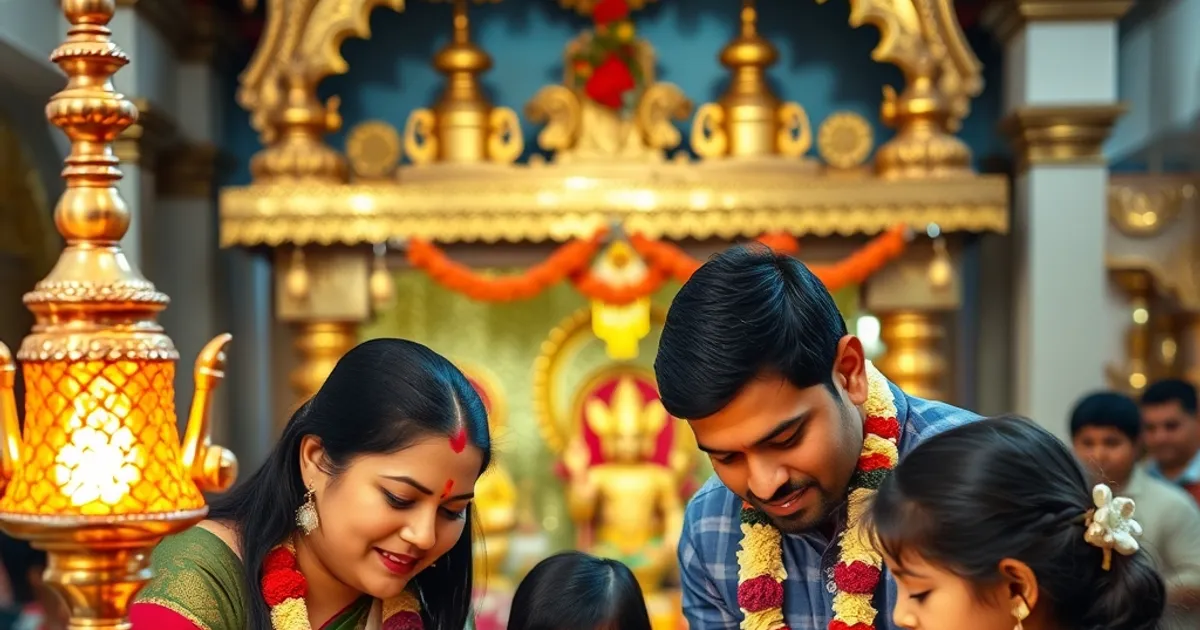
Sri Bhagavathi Seva on August 1 is one of the observances specific to this season that deserves particular attention from Troy families. This is a temple ritual honoring the goddess — Bhagavathi, a form of the divine feminine celebrated in South Indian and Kerala Hindu traditions — through elaborate puja, lamp ceremonies, and sometimes music and floral offerings.
For children experiencing temple ritual for the first time, or for those building familiarity with temple culture, Sri Bhagavathi Seva offers a sensory-rich experience: the smell of incense and camphor, the sight of oil lamps reflected in brass vessels, the sound of priests chanting. These sensory memories are among the most durable ways children internalize cultural heritage.
Parents can prepare children in advance by explaining who Bhagavathi is and what seva means — "service" or "worship" — framing the visit as participation rather than observation. Many children respond to the idea that they are there to do something, not just watch. Even the simple acts of receiving prasad or lighting a lamp create a sense of involvement that makes the experience more meaningful.
Insider Tip: For families bringing young children to temple observances, arriving during the preparation period rather than at the peak of the puja often works better — the quieter setup phase allows children to move around, ask questions, and observe details without the crowds and intensity of the main ceremony. Most temples welcome families with children throughout the day.
Sankashti Chaturthi and the Ganesha Conversation
Sankashti Chaturthi arrives on August 2, the day after Sri Bhagavathi Seva, making for a packed start to the month. This monthly fast day devoted to Ganesha provides a natural teaching moment. Ganesha — the elephant-headed deity, son of Shiva and Parvati, remover of obstacles — is arguably the deity most children in Indian-American families encounter first, given his prominence in temple entrances, household altars, and popular imagery.
Parents observing Sankashti Chaturthi can use the occasion to deepen a child's relationship with what they already know. Why does Ganesha have an elephant head? What does it mean to remove obstacles? What obstacles does the child face, and how might Ganesha's qualities — wisdom, patience, humor — help? These conversations, woven into the experience of fasting or reduced eating, give children a framework for understanding what observance actually means.
Ekadashi, Pradosh Vrat, and Learning the Lunar Calendar
Ekadashi on August 8 and Pradosh Vrat on August 10 fall within two days of each other, creating an excellent two-day opportunity to teach children about how the Hindu lunar calendar works. Ekadashi — the eleventh day of the lunar fortnight — is a fasting observance tied directly to the moon's cycle, and explaining this to children opens the door to a broader lesson about how Indian culture has historically counted time.
The concept that there are two Ekadashis every month (one in the waxing phase, one in the waning), and that the calendar month is organized around the full moon and new moon rather than a fixed 30-day cycle, tends to genuinely interest children who have any curiosity about science and mathematics. The lunar calendar is not a simplification — it is a sophisticated system, and framing it as such engages older children in particular.
Amavasya on August 12, the new moon, provides another teaching moment: this is the traditional day for remembering ancestors, for acknowledging the family members who came before. For children, understanding that they are part of a lineage — that they have great-grandparents who grew up in India, who had their own children, who made decisions that eventually led to the family being in Troy, Michigan — gives the observance personal stakes rather than abstract tradition.
Nag Panchami 2026: Mythology That Sticks
Nag Panchami 2026 falls on August 17 and is, for many children, one of the most memorable Hindu observances of the calendar year. The imagery is vivid: serpent deities, offerings of milk, the great cosmic snake Shesha upon whom Vishnu rests, the snake that sheltered the infant Krishna. The mythology connected to Nag Panchami gives parents material for storytelling that most children find genuinely engaging.
Families in Troy can observe Nag Panchami with temple visits, the drawing of snake images, or simply with the stories — reading or telling the connected myths is itself a form of participation. For children who have been building familiarity with Hindu tradition throughout the July-August calendar, Nag Panchami lands at the end of a month full of observances with something that feels conclusive and memorable.
FAQ
What is the best age to start bringing children to temple observances? There is no fixed answer — temples in the Troy area welcome children of all ages, and even very young children benefit from the experience of being in a sacred space with family. The key is managing expectations: shorter visits, advance explanation, and following the child's energy rather than the full program schedule.
How do you explain fasting to children without making it feel punitive? Framing fasting as a practice of attention — eating less to be more aware — rather than deprivation helps. Many Indian-American families allow children partial participation: eating simply rather than fasting fully, while still marking the day as different from a regular one.
What is Sri Bhagavathi Seva specifically? Sri Bhagavathi Seva is a ritual of worship honoring Bhagavathi, a form of the goddess prominent in South Indian and Kerala Hindu traditions. The seva involves elaborate puja, lamp ceremonies, and offerings, performed by priests in a temple setting.
Are there Indian cultural schools in Troy, MI for children? The Metro Detroit area has a well-developed network of Indian cultural education, including language classes, classical dance and music instruction, and Hindu religious education programs. Local temple communities and cultural organizations are the best starting point for finding current programs.
Bottom Line 🧒
For Indian-American families in Troy, the July-August panchang is not just a religious calendar — it is a curriculum. From Guru Purnima 2026 and Sri Bhagavathi Seva at the start of the season through Sankashti Chaturthi, Ekadashi, Pradosh Vrat, Amavasya, and Nag Panchami 2026, every observance is an opportunity to teach children something that cannot be learned from a textbook: what it means to belong to a tradition, to count time by the moon, and to carry a cultural identity that spans continents and generations.