
Arts & Entertainment in Lucknow
TL;DR
- Lucknow's late-July spiritual calendar packs Ekadashi, Pradosh Vrat, Purnima, and Guru Purnima 2026 into one remarkable week
- The city's Nawabi tehzeeb shapes how religious observances unfold — with elegance, music, and communal warmth
- Kathak, thumri, and ghazal remain living traditions here, not museum pieces 🎶
- Sankashti Chaturthi on August 2 closes the fortnight with quieter, devotional energy
- Street celebrations and private mehfils run simultaneously — the city operates on multiple frequencies at once
Lucknow does not simply observe its calendar. It performs it.
This is a city where the muezzin's call overlaps with temple bells, where classical dance academies stand near Shia imambargahs, and where the Nawabi instinct for ceremony has survived every political upheaval of the last two centuries. As July turns to August, the schedule grows particularly full — five significant observances arriving in rapid succession, each pulling the city in its own direction while somehow pulling together.
The Rhythm of Observance: Ekadashi to Purnima
Ekadashi falls on July 25, marking the eleventh day of the lunar fortnight — a day of fasting and prayer observed by Vaishnavite households across the city. In Lucknow, this is not a quiet domestic affair. Temples along the Gomti embankment draw steady streams of devotees, many arriving before sunrise. Food stalls that normally thrive near temple precincts stay closed or pivot to sattvic offerings, and the relative hush of a fasting city creates an unusual atmospheric shift.
Two days later, on July 27, Pradosh Vrat arrives. Dedicated to Lord Shiva, this bi-monthly fast focuses on the twilight hour — the pradosh kaal — when prayers carry particular potency according to tradition. In Lucknow, this intersects with a strong Shaiva presence in localities like Aliganj and the older neighborhoods near the Hussainabad area. Devotees gather for evening abhishek ceremonies; temples stay lit well past dark.
Then the week culminates in something larger. July 29 carries both Purnima — the full moon — and Guru Purnima 2026, one of the most emotionally resonant occasions in the Hindu calendar. Guru Purnima 2026 is dedicated to honoring one's teacher, whether that teacher is a religious preceptor, a classical arts guru, or an academic mentor. In a city as deeply invested in classical training as Lucknow, the occasion has particular gravity.
Guru Purnima 2026 and the Guru-Shishya Tradition
Few cities in South Asia have maintained the guru-shishya relationship — the transmission of knowledge from master to student — as consciously as Lucknow. Kathak dance, which took its most refined form here under the patronage of the Nawabs of Awadh, remains a living lineage rather than a preserved artifact. Thumri vocalists trace their style back to courtly mehfils of the nineteenth century.
On Guru Purnima 2026, disciples across the city will gather to offer formal reverence to their ustad or guru — presenting garlands, touching feet, sitting for darshan. But in Lucknow, the observation frequently extends into performance. Institutions like the Bhatkhande Music Institute stage commemorative programs where senior artists present compositions they learned from their own masters. These are not polished recitals aimed at public applause; they are acts of gratitude, and the air in the hall reflects that.
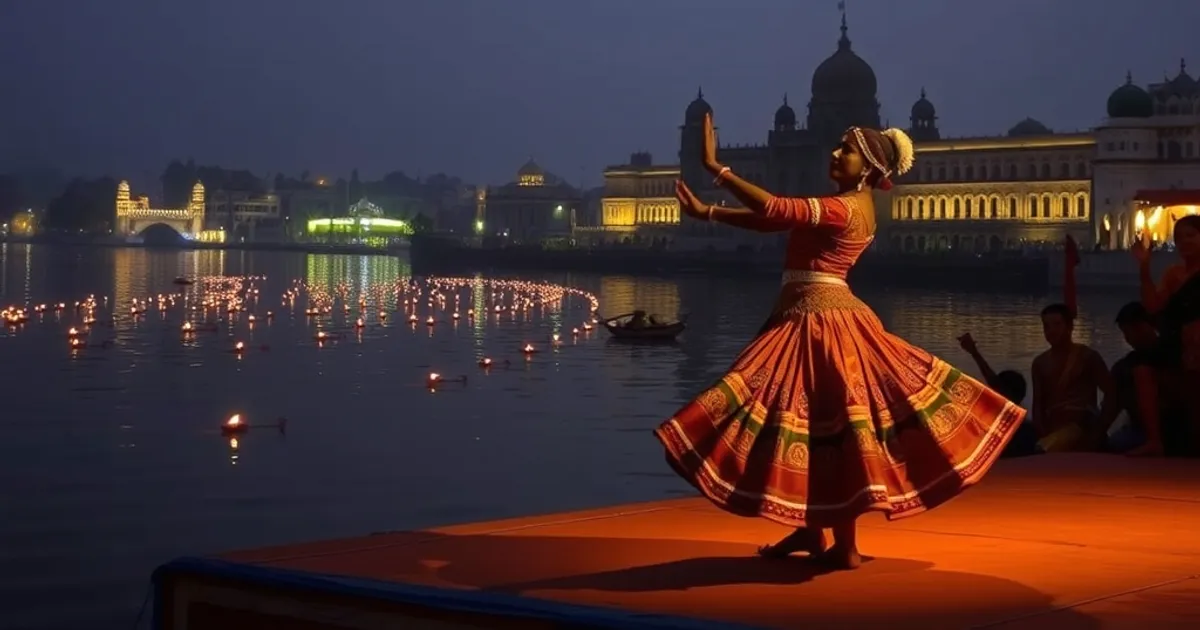
The full moon of Purnima adds its own layer. Evening gatherings often move outdoors, and the Gomti riverfront becomes a site for both personal prayer and communal celebration. Diyas float on the water; vendors sell jasmine garlands; somewhere nearby, a harmonium starts up.
Insider Tip
If you want to experience Guru Purnima 2026 as locals do rather than as observers, seek out a smaller institution — a neighborhood Kathak school or a sitar teacher's home studio — rather than a large auditorium event. The intimate gatherings are where the actual emotional weight of the occasion is felt. Arrive with some understanding of the guru-shishya relationship; you'll be welcomed more readily and the evening will make more sense.
The Classical Arts Ecosystem
Lucknow's arts calendar runs on two tracks that rarely intersect neatly: the formal institutional one and the informal one happening in drawing rooms, courtyards, and neighborhood temples. Both are worth attending.
The formal track includes concerts at established venues, dance performances tied to festival cycles, and academic programs hosted by the city's music colleges. The informal track is where Lucknow's most distinctive culture lives — ghazal evenings that start at ten and run until two, thumri recitals held in old havelis, tabla-playing sessions that are equal parts practice and socializing.
Kathak here carries the specific inflection of the Lucknow gharana: lyrical, sensuous, concerned with abhinaya (expressive interpretation) as much as footwork. A performance in this style — even a student performance on Guru Purnima 2026 — reveals how differently this city thinks about the relationship between music and movement.
Sankashti Chaturthi and the August Transition
Sankashti Chaturthi arrives on August 2, dedicated to Lord Ganesha and observed on the fourth day after the full moon. For many households, this is a fasting day that ends only after moonrise and the sighting of the moon. In Lucknow, Ganesha worship carries a particular neighborhood character — local mandals organize small-scale puja arrangements, and certain localities have long-standing traditions of elaborate evening aarti.
What Sankashti Chaturthi does, functionally, is close out a remarkable fortnight. Ekadashi, Pradosh Vrat, Purnima, Guru Purnima 2026, and finally Sankashti Chaturthi — a sequence that has moved through Vaishnavite observance, Shaivite devotion, full-moon celebration, and Ganapatya worship. The range itself tells you something about Lucknow: this is a city with multiple religious streams running simultaneously, each given its due.
FAQ
Is Guru Purnima 2026 a public holiday in Lucknow? It is not typically a gazetted public holiday, but many businesses and institutions observe informal closures or reduced schedules, particularly those connected to arts and education.
What is the significance of Ekadashi fasting? Ekadashi fasting is a Vaishnavite practice observed on the eleventh day of each lunar fortnight. Devotees abstain from grains and certain foods; the day is associated with devotion to Lord Vishnu.
Can visitors attend Kathak performances during this period? Yes. Many institutions hold open programs around Guru Purnima 2026. Check with local cultural organizations for schedules; tickets for institutional programs are typically available at the venue.
What distinguishes the Lucknow gharana of Kathak from other styles? The Lucknow gharana emphasizes grace, expressive nuance, and thumri-influenced layering. It developed under court patronage and retains a lyrical quality distinct from the more percussive emphasis of the Jaipur gharana.
What is Pradosh Vrat and how often does it occur? Pradosh Vrat falls twice each lunar month — on the thirteenth day of both the waxing and waning moon — and is dedicated to Lord Shiva. The evening twilight period is considered especially auspicious for worship.
Bottom Line
Lucknow in late July and early August is not a city at rest. Ekadashi, Pradosh Vrat, Purnima, Guru Purnima 2026, and Sankashti Chaturthi arrive in a rush, and the city meets each one with its characteristic combination of devotion and elegance. The arts scene here is not separate from this spiritual rhythm — it is woven through it, expressing itself most fully in the moments when tradition and the present tense briefly coincide.